
Homeopathy
Homeopathy consists of the set of procedures used to apply the only known therapeutic principle with a view to curing patients: the principle of similars.
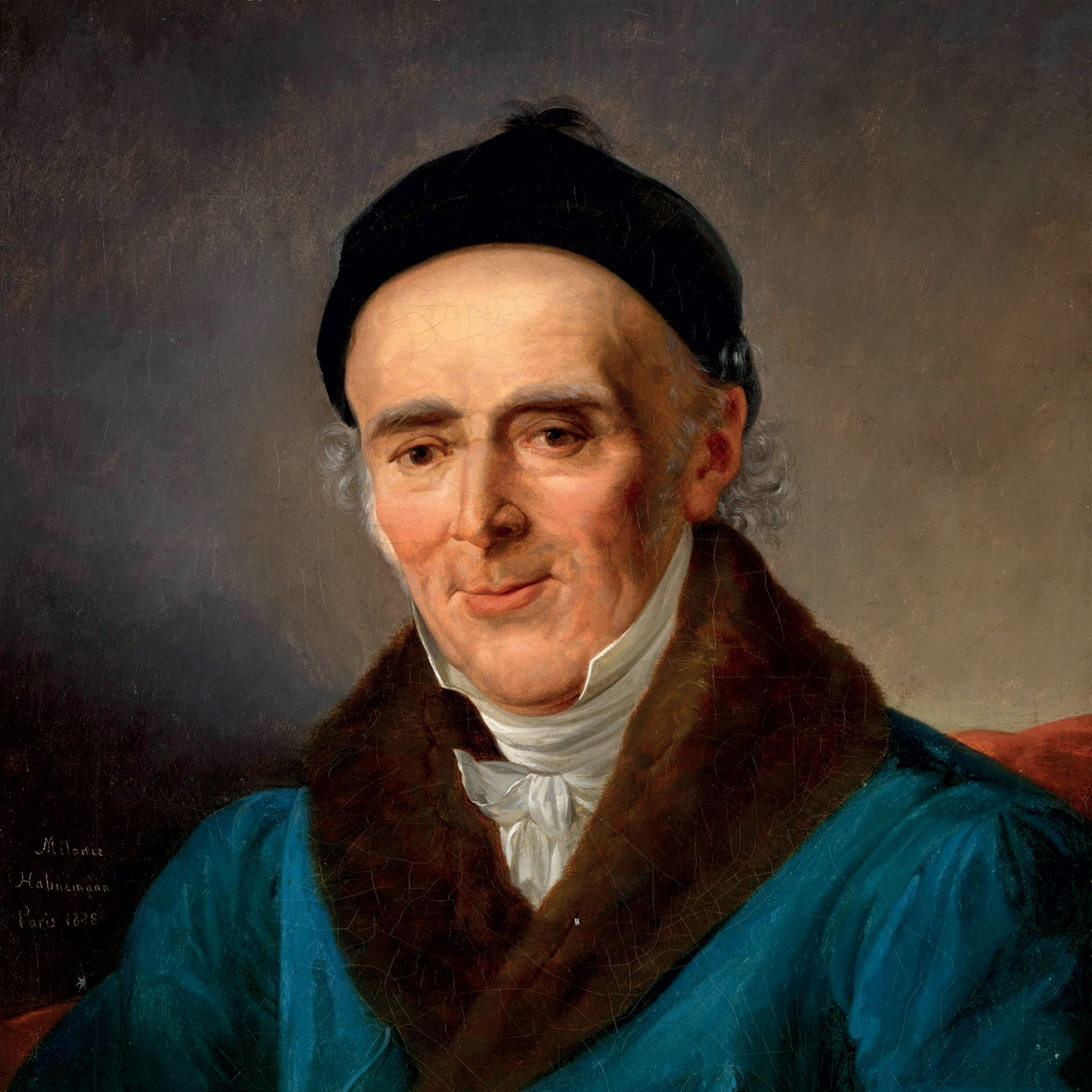
Therapeutic results are only achieved if the principles laid down by the founder of homeopathy, Dr Samuel Hahnemann, during 55 years of clinical observation and experimentation, are strictly adhered to. Appalled by the very haphazard way in which Parisian doctors were applying his discoveries whilst continuing to practise bloodletting, Hahnemann uttered his famous words: “Imitate me, but imitate me well! “Alas, for nearly a century, the homeopathic world seems to have forgotten even the existence of the Organon, the book in which Hahnemann recorded his discoveries. Consequently, homeopathy has been taught according to arbitrary views devised by people who have never fully mastered the art, nor even read the Organon. With each generation, the standard of competence has declined to the current deplorable state, where gurus impose increasingly deviant views on a credulous and increasingly uneducated audience. The common thread running through all these deviations is the desire to elevate to the status of an absolute value something that will always remain merely relative: “vaccine barriers”, “the sensation”, “the periodic table”, “souchism”, etc.
Gestalt
Throughout the 291 aphorisms of the *Organon*, Hahnemann presents a logical argument based on reasoning and clinical observation. Each of these 291 aphorisms is relatively independent of the others, which demonstrates that there is no single proposition possessing absolute value, but only relative propositions that make sense when considered as a whole. The Organon enables one to become a homeopath only when applied in its entirety; it may be supplemented, but nothing may be omitted – what Hahnemann calls the “Gestalt”. What we are saying here about homeopathy will, as we shall see below, apply to the patient themselves, who cannot be reduced to a single symptom.
Non-reductionism
Gestalt theory provides the conceptual framework suited to a non-reductionist perspective. Reductionism has enabled remarkable progress in the sciences of the inanimate world, as it can be assumed that atoms have remained unchanged since the beginning of time. This is not the case with biological entities, which have been evolving for billions of years. Reducing human beings to organs, then organs to cells, and then cells to biological mechanisms contributes absolutely nothing to medicine.
All symptoms
It follows from this reality that every patient presents a whole range of symptoms, which conventional medicine seeks to reduce to the single symptom it is interested in treating on that particular day – an arbitrary approach that is entirely unscientific. As the patient cannot be reduced to a single diseased organ, the only way to address the problem is through the totality of their symptoms, which indirectly characterise the invisible inner workings of the body. It is this totality that defines the case; it is the concept of ‘signifying totality’, a combination that is unique to each patient.
(a) The principle of individualisation
This gives rise to the Principle of Individualisation, which is essential to prescribing. It is by characterising the case in full detail – particularly its most unique aspects – that the homeopathic doctor will be able to identify the appropriate remedy.
(b) Life force
If such a pattern persists in a patient, there must be a common underlying cause behind these symptoms, such that the whole represents the manifestation of this internal disorder, which remains directly invisible. Logic dictates that this disorder lies at a level prior to the organs themselves. Thus, homeopaths are vitalist practitioners: reflection leads us to believe that “the manifestations we call diseases are based solely on a disruption of the vital energy”, as Hahnemann put it.
(c) Eternal relief
It follows from all this that everything we can observe with the naked eye or under a microscope is merely the result of an underlying dynamic disturbance (apart, of course, from an external traumatic cause) and in no way the cause of the illness. Furthermore, any treatment aimed at eliminating these symptoms can only be palliative and is doomed to failure in the long run. This is what we have always observed with allopathic prescriptions.
Ownership of medicines
Experiments and cases of poisoning observed over the centuries demonstrate that all active drugs have the potential to disrupt the body, causing a unique clinical picture.
(a) Total action
It follows that all drugs, medicines or other active substances are also capable of bringing about a ‘totality’, which demonstrates both their general effect and the fact that the body reacts as a whole. Just as every patient embodies a ‘totality’, so too does every medicine, capable of leaving its own unique mark on the living organism.
(b) “Side” effects”
Just as it is arbitrary to seek to isolate a single symptom in a patient whilst disregarding the rest of the symptoms or dismissing them as “secondary”, it is equally arbitrary to speak of the “side effects” of a medicine: they are quite simply the remainder of its overall effect on the body.
(c) Sensitivity or susceptibility
When asked “Does alcohol make you drunk?”, the answer varies depending on the quantity consumed and the individual’s susceptibility to alcohol. It is exactly the same for drugs used in medicine. There is a continuum of individual susceptibilities, which can be predicted using homeopathic “tools”. These phenomena lie at the very heart of the healing process, thanks to the action of a substance that may or may not be recognised by the body. Conversely, it is also through a phenomenon of susceptibility that we fall ill: mere exposure to a triggering factor, such as the cold or a microbe, is not enough; there must first be a susceptibility, which is itself directly dependent on the patient’s state of health.
Why might a medicine that has clinically benefited one person prove ineffective or even downright toxic in another? This is a central question in medicine, one that nobody seems to ask. Only homeopathy provides answers, which we can only touch upon briefly here. The patient’s susceptibility is directly linked to a disturbance in their internal state – which is dynamic in nature – and to the fact that, as life is governed by chaotic mechanisms, even a very slight change can have enormous repercussions. Most people will be able to react to a substance in a massive (toxic) dose; only a few highly susceptible individuals will react to much smaller quantities, but sometimes in a severe or explosive manner.
Interaction between two wholes
Homeopathy shows us that the absorption of any active substance leads to the interaction of two totalities: that of the patient and that of the remedy. When the two interacting totalities have nothing to do with one another – that is to say, when their respective symptoms are dissimilar – there is no particular susceptibility. Nothing happens, unless one persists by administering continuous and increasing doses, in which case a toxic picture may develop and more or less supplant the initial pathological picture.
On the other hand, if the two totalities are similar – that is to say, if the pathological picture of the administered drug resembles the totality manifested in the patient – then there is a high degree of susceptibility, and in this case the interaction is extremely violent.
(a) Revitalisation
It is because of these phenomena of major aggravation that the Law of Similars has remained unexploited since the dawn of medicine. It was upon observing these frightening symptoms for himself that Hahnemann came up with the idea of drastically reducing the doses to the point where he knew full well that no chemical trace of the substance remained… yet this still did not prevent the body from reacting to the presence of the medicine. This process of fractionation and succussion is called potentisation, and is not merely a dilution; anyone can try pouring a drop of strychnine into the ocean.
(b) Interaction of forces
Although recent discoveries point to crystalline microstructures within water, no one has yet been able to explain the nature of the dynamisation process. We shall bear in mind that only a dynamic agent can be perceived by the “imbalanced” vital force, and it is indeed on this dynamic, non-material plane that healing takes place. Naturally, these concepts have been rejected by scientific materialism ever since Hahnemann’s time, and today these ideas are opposed with the same vehemence. Yet they stem from simple observation and logical reasoning.
(c) Homeopathy
It is always the case that, when two similar totalities interact, the stronger one will be capable of destroying the weaker one. This is what Hahnemann states (Organon §26):
In a living organism, a weaker dynamic condition is permanently suppressed by a stronger one, provided that the latter (whilst belonging to a different species) is nevertheless very similar to the former in its manifestation.
In 30 years of practice, I have found it impossible to refute Hahnemann’s conclusions, which we have just briefly outlined here. The aim of the School is to make the knowledge that is so often neglected in homeopathy today accessible to as many people as possible, to raise public awareness, and to train the next generation of competent homeopaths.