
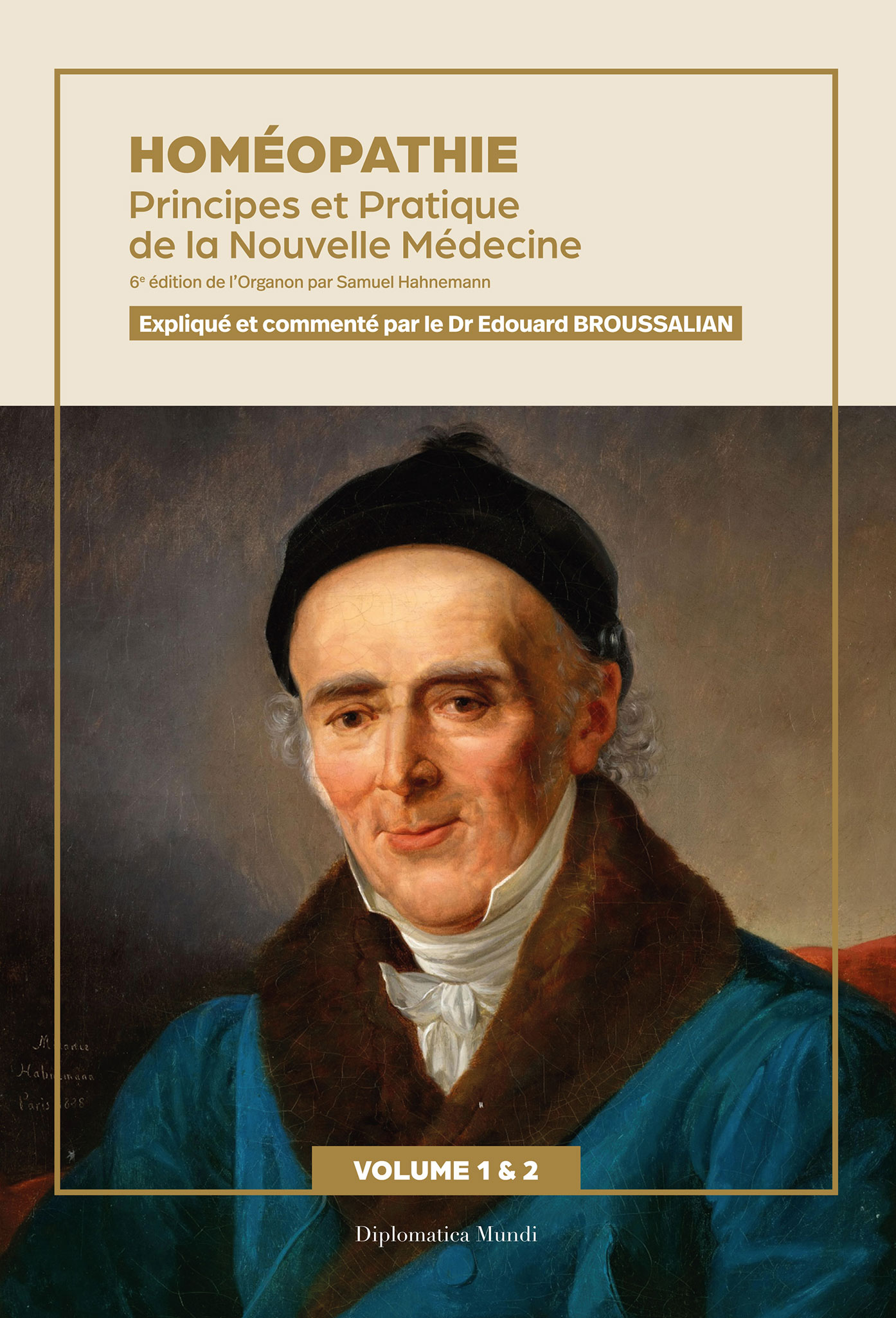
Homeopathy – Principles and Practice of New Medicine, Volumes 1 & 2 – Dr. Edouard Broussalian
CHF 195.00
Dans cette nouvelle édition de 2025, Le Docteur Édouard Broussalian re-traduit et commente, en deux volumes, les deux-cent-nonante-et-onze aphorismes de la sixième édition de l’Organon, ouvrage écrit par le célèbre Samuel Hahnemann, découvreur de l’homéopathie.
36 en stock
Description
Dans cette nouvelle édition de 2025, Le Docteur Edouard Broussalian re-traduit et commente, en deux volumes, les deux-cent-nonante-et-onze aphorismes de la sixième édition de l’Organon, ouvrage écrit par le célèbre Samuel Hahnemann, découvreur de l’homéopathie.
L’Organon de l’art de guérir se veut, fidèle à son étymologie, l’outil de tous les homéopathes. Cet instrument de travail, lumineux et mal aimé est délaissé par des générations de praticiens, depuis sa première édition en 1810. Hahnemann n’a pourtant cessé de le retravailler et de le perfectionner jusqu’à la 6 ème édition posthume publiée en 1920. Hahnemann était un scientifique du siècle des lumières, d’une culture littéraire et scientifique incroyables, persuadé que la médecine était fondée sur des bases scientifiques et qu’il fallait la réformer. A partir d’observations scrupuleuses sans cesse répétées tout au long de sa vie, il a rendu possible l’application de la loi des semblables par un ensemble de théorèmes cohérents régissant la prescription thérapeutique. Pour résumer, sans connaissance de l’Organon, pas de réussite pérenne dans la prescription homéopathique ni de guérison de maladies aigues et chroniques. Examen du malade, miasmes, pathogénésie, maladies dissemblables, …, toutes les notions fondamentales y sont exposées avec l’extrême rigueur et la concision du fondateur.
Volume 1 contains paragraphs 1 to 70 of the Organon, the fundamental theoretical principles that form the first part of this work of pedagogical adaptation. By bringing it up to date and explaining its historical context, with commentaries and additions of practical and clinical notes, this work aims to help all lovers of homeopathy rediscover this marvellous text that has not aged a day!
After defining the General Principles of the New Medicine in Volume One, Hahnemann goes on to describe the practical application of the medical art in paragraphs 71 to 291, defining three main lines of development:
1. Establishing pathological criteria
2. Therapeutic study of drugs
3. Therapeutic application of drugs and individualization,
This represents nothing less than the application of the medical art as a physician should know it.
We're not talking about scientific subjects such as immunology, pathology, histology and so on. Our focus here is on the essentials: diagnosis and treatment.
It will not escape the notice of any doctor capable of observing that, unfortunately, the classic diagnoses as we have been taught them are increasingly unlikely to be made, and that they are being replaced by syndromes that are less and less comprehensible, with pictures that are as vague as they are diffuse. This is, of course, a reflection of the decline in the population's level of health.
The physician must have studied these different illnesses and their attendant signs and symptoms. But the ideal, and indeed our duty, is to keep abreast of the latest discoveries in this field.
Further information
| Weight | 2,400 kg |
|---|---|
| Dimensions | 24.7 × 17.7 × 8.6 cm |
| Pages | 1230 p. (Volume 1: 286 p.; volume 2: 944 p.) |