

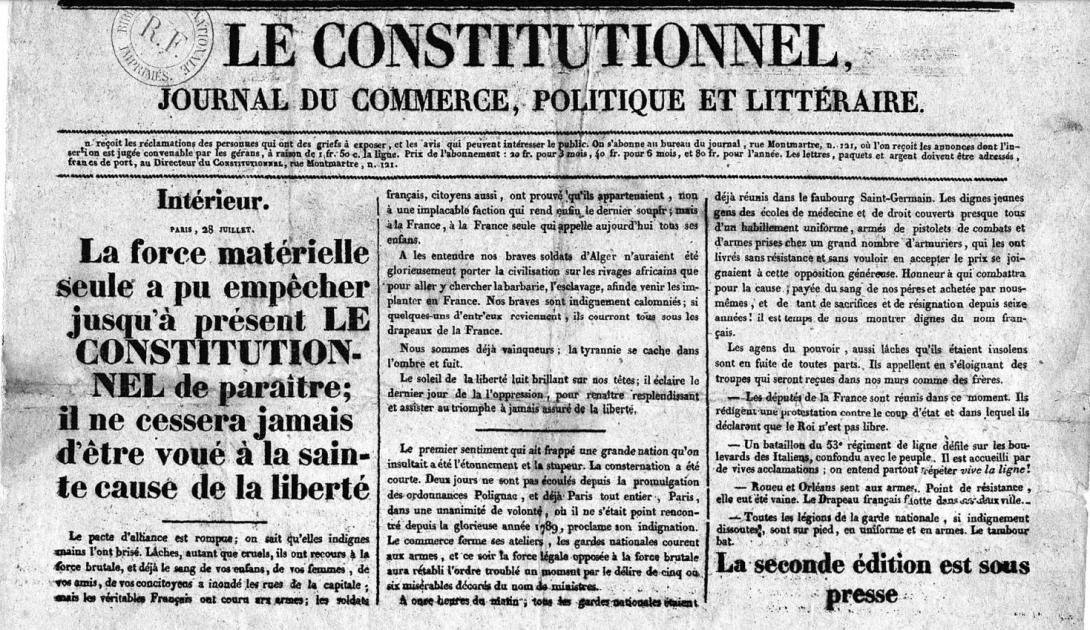
The year is 1834. Hahnemann is still living in his“retreat” in Köthen. He has just met Marie Mélanie d’Hervilly and likely has no idea that he is about to embark on a new chapter of his life with her—in France! In this country that is both so close and yet so far away, where homeopathy is still almost in its infancy. Only a few French-speaking doctors who had visited Hahnemann in Köthen, or corresponded with him and seriously studied his books, were familiar with homeopathy and could practice it successfully. Otherwise, what is known about it? As evidenced by the rare mentions of it in the press of the time, here and there homeopathy is mentioned only in reports from abroad; its name and the tiny doses are used to employ dubious and more or less ironic figures of speech, or as a comparison regarding this and that. Sometimes, too, its successes were disputed. And already it was being mocked to the point of being called quackery, so much so that the sheer absurdity of it all, having clearly reached its limit, made some people’s hair stand on end.

Amid the rumors and the confusion that seemed to surround homeopathy at the time, a few conscientious—or simply curious—columnists had the good sense to present their readers with an account of what they could reliably ascertain about this new approach to treating the sick. Consequently, one had to read Hahnemann (and still must!), at least in French*, to understand what it was really about and to have at least a correct overview of homeopathy before presenting the subject, and then to critique it later if necessary. Quod licet Jovi, non licet bovi.
With this in mind, we would like to present one of these rare non-polemical texts, found in the most important newspaper of the time, beyond its appeal as a literary curiosity. While, as a popular science article, it is not without its inaccuracies or clumsiness (see the notes), it nonetheless constitutes a fairly faithful and comprehensive summary of Hahnemann’s seminal work. The cornerstones of the homeopathic method are finally laid out in sequence, which holds educational value for the average reader of our time, who is more accustomed to encountering in the media the same old, simplistic trio: similarity, “infinitesimal,” and“totality.” We invite you to discover (or rediscover) them step by step, hoping that some of the less well-known points will strike a chord with you**. Finally, it should be noted that the author, who was acutely aware of the devastating effects of the medicine of his time, concludes with a personal note that is both optimistic and progressive.
Enjoy the read.
* That said, it should be noted that Jourdan’s 1834 French translation of the fifth Organon, which was not always accurate, did not necessarily help commentators of the time.
** For more information: https://www.youtube.com/watch?v=i-59Fs326Ng
SCIENTIFIC JOURNAL OFHOMEOPATHICMEDICINE
Published in *Le Constitutionnel, Journal of Commerce, Politics, and Literature*, Issue 294, October 21, 1834, pp. 1–3
https://gallica.bnf.fr/ark:/12148/bpt6k655064c/f1.item
https://www.retronews.fr/journal/le-constitutionnel/21-oct-1834/22/478593/1
Proofreading, revisions, additions, and notes by Athelas, September 2019
We need to talk about a new system1,2 of medicine. When I say new, we must be clear, for, across the Rhine where it originated some thirty years ago, it stirred up nearly all the rigid, medical minds of the Germans, who have produced volumes for and against it enough to fill the Royal Library; but since it has crept in among us of late, and since it presents itself with promises that are quite enticing to all patients who wish to be cured, we must not cast it out without first getting to know it. And who knows if, after giving it the initial welcome due to a newcomer, we might not grant it a place among us? We have certainly welcomed the nebulous philosophy imported from the same regions by Mr. Cousin. I am not saying that homeopathic medicine is an absurdity, God forbid; I have read, seen, and heard too much about medical theories to cry foul on the latest arrival, which, after all, is every bit as good as its predecessors. Besides, so much the better for it: if it is an absurdity, it has an infallible chance of success3 ; for our poor humanity is doomed to repeat all too often with Saint Augustine: Credo quia absurdum4. In any case, I must tell you right away that homeopathic medicine makes a clean sweep of all the theories, whatever they may be, that preceded it, and that it undertakes to cure all diseases that are curable, in a matter of hours5, without convalescence, and effectively. Good luck to homeopathic medicine, if it keeps its word! Farewell, then, to the “humoral” doctors [both literally and figuratively, editor’s note] who declared that all diseases stemmed from sinful, acidic, alkaline, bilious, etc., humors, and that these humors must be expelled through emetics, purgatives, sudorifics, and diuretics! Farewell to the “solidists”6 who, maintaining that all disease resides essentially in the solid parts of our organism, claimed that the alteration of humors is merely the result of the alteration of organs, and that one must therefore weaken or stimulate, constrict or relax! Farewell to the alchemist doctors who saw in the human body nothing but stills and crucibles, as well as to those who regarded it merely as a hydraulic machine! Farewell to doctors who always want to bleed you, and to those who never want to bleed you, as well as to those who want to cure you—and even make you immortal—by injecting new blood into your veins! Farewell to Sangrado, to Purgon, to quack doctor, and long live homeopathy7 !

What, then, is homeopathy? The word is composed of two Greek terms meaning “similar disease,” because its fundamental principle consists of administering, to cure any illness, a remedy , when given to a healthy person, produces effects similar to—or as close as possible to—those of the disease being treated. In other words, homeopathic medicine adopts the motto similia similibus curantur, in contrast to traditional medicine, which treated diseases with remedies that were their opposites, according to the principle contraria contrarias curantur.
Hahnemann, the leader of this new school, was led to accept this fundamental principle of his system while seeking to explain the febrifuge properties of cinchona, dissatisfied as he was with the unfounded hypotheses that had been put forward on this subject. He conducted a few experiments on himself with this substance. He was greatly astonished when he observed that cinchona produced in healthy individuals an intermittent fever very similar to the one this remedy most often remedy , and that it also induced several varied symptoms that had never been noticed before. Struck by this observation, the author wondered whether the febrifuge property of cinchona did not depend on this ability to induce in healthy individuals a condition similar to intermittent fever, and whether this well-established fact might not hold true for other substances capable of producing conditions similar to those they cure. With incredible patience, he devoted himself to these trials for many years, using himself as the subject of his experiments. Deprivation of every kind, a strict regimen, daily suffering caused by the ingestion of medicines, many of which are active poisons—he subjected himself to everything in order to discover the law he sought so ardently.
Every medicinal substance was studied down to the finest details of its effects on the human body. As he carried out this work, he soon realized that the drugs known as specific8 owed their efficacy to their homeopathic action. Thus, mercury cures syphilitic conditions because mercury produces symptoms in a healthy individual that bear the closest resemblance to those of syphilis; the smallpox virus9 protects against smallpox by developing symptoms whose resemblance to those of the disease no one would dispute; belladonna cures scarlet fever because this substance produces analogous or nearly similar effects. Opium cures lead colic or painters’ colic because it causes constipation analogous to that of lead colic. Cantharides are regarded as the true specific remedy for rabies, because observation has revealed that this remedy Cantharis] produces, in healthy humans, the most consistent symptoms of rabies, namely, difficulty swallowing and a horror of water. Homeopathic physicians also pride themselves on curing cholera morbus at least nine times out of ten through the use of copper or white hellebore, because these substances produce effects that closely resemble those of cholera. Finally, there is no disease, however serious it may be, that does not have in nature an analogous remedy of certain efficacy. One immediately realizes the immense amount of research the physician must undertake to reach the point where he can say: given a set of pathological symptoms, which substance produces analogous or similar ones, since it is that substance alone that can cure the disease?
According to Hahnemann’s system, it is never necessary for the physician to inquire into the cause of diseases, for that cause is unknown to us. But although we cannot know it, we know that it is intimately linked to the symptoms; and we can easily assess these symptoms and make them disappear by artificially inducing analogous symptoms. How, indeed, does the smallpox vaccine protect the body from smallpox infection, if not by substituting a very similar action, and thereby capable of excluding any influence of the same nature? And the same applies to mercury for syphilis, cinchona for intermittent fevers, pasque flower for whooping cough, etc. It is not easy to conceive that by adding an affection similar or analogous to the one that already exists, the latter would disappear, or that at least the artificial affection would not remain in place of the one it has driven out. The sum of two or more units cannot possibly be zero. However, if the results were as claimed, we would have to accept them and leave our reasoning for what it is: We do not decide; we merely present.
The physician, says Hahnemann, has nothing else to cure in diseases but the patient’s suffering and the disturbances of the regular rhythm, which are perceptible to the senses—that is, the totality the mass of symptoms through which the disease indicates the remedies capable of providing relief; all the internal causes that might be attributed to it, all the occult characteristics that one might wish to ascribe to it, are nothing but vain fantasies.
The condition of the body that we call disease can only be transformed into a state of health through a disturbance of the body induced by drugs. The curative power of these drugs consists solely in the change they bring about in the patient’s condition, that is, in the specific production of pathological symptoms. Experiments conducted on healthy subjects are the best and surest means available for recognizing this power. Any experiment attempted on a sick individual would be absurd, useless, and unscientific.
Based on all known facts, it is impossible to cure a disease using medicines that, in and of themselves, have the ability to produce, in healthy individuals, an artificial condition or symptoms that are contrary to the disease. This form of medicine, which relies on opposites, therefore never brings about a cure. Nature itself never brings about cure in which one disease is destroyed by another disease added to it, no matter how severe that new condition may be.
All the evidence also points to the fact that a remedy of inducing, in a healthy person, a pathological symptom opposite to the disease to be cured, produces only temporary relief in a long-standing illness, never provides a cure always allows the disease to recur, after a certain time, in a more severe form than it was previously. The curative method based on opposites, which is purely palliative, is therefore entirely contrary to the goal sought in diseases of any significance. The true method, the only one to which one can still resort, is the homeopathic method, which employs, against the totality a disease’s symptoms, a remedy of provoking, in a healthy individual, symptoms as similar as possible to those observed in the patient. It is the only one that is truly beneficial, the one that always eradicates diseases or aberrations of the body’s functions in an easy, complete, and rapid manner. Nature itself sets the example; in this regard, when a new disease similar to an existing one is introduced, it cures the condition promptly and permanently.

Under no circumstances is it necessary to use more than one remedy at a time. The true physician (meaning a homeopath) finds in unmixed medicines everything he could wish for, that is, artificial morbific potencies [i.e., those capable of causing disease] which, through their homeopathic faculty, completely cure natural diseases; and since it is a very wise precept never to attempt to achieve with multiple potencies what can be accomplished with a single one, it will never occur to him to prescribe anything other than a single remedy at a time. Nor is he unaware that a remedy , when given for a disease whose totality of symptoms perfectly resembles those produced by the remedy, cures it perfectly.
But the selection of a remedy a specific case of illness is based not only on its perfect similarity to the symptoms, but also on the minute dose in which it is administered. If a dose of a remedy—even a strictly homeopathic one—is too strong, it will inevitably harm the patient, even though the medicinal substance is beneficial by nature; for the resulting effect is too strong, and is felt all the more keenly because, by virtue of its homeopathic nature, the remedy acts precisely on those parts of the organism that have already been most affected by the natural disease. The increase in dose itself causes all the more harm to the patient the more homeopathic the remedy is, and a strong dose of a remedy will do more harm than a dose of an opposite or dissimilar substance, for then the artificial disease, very similar to the natural disease, which the remedy has excited in the most afflicted parts of the organism, goes so far as to cause harm, whereas, had it remained within proper limits, it would have effected a cure , easy, and certain cure .
The question now is: what is the appropriate degree of dilution to best impart both certainty and gentleness to the beneficial effects we seek to produce? In other words, to what degree must the dose of the homeopathic remedy be diluted in a given case of illness to achieve the best cure ? The solution to this problem cannot be found through theoretical conjecture. All conceivable subtleties would be of no use, and it is clear that only through pure experimentation and precise observations can one reach the goal. Now, these experiments establish that, when the disease does not clearly depend on a profound alteration of an important organ, and when care is taken to remove all foreign medicinal influences from the patient, the dose10 of the homeopathic remedy can never be too weak to make it less potent than the natural disease it can extinguish and cure, as long as it retains the energy necessary to provoke, immediately after being taken, symptoms slightly more intense than the patient’s own. It would be absurd to object to the high doses used in conventional practice, whose medicines are not directed at the affected parts themselves, but only at those that are not affected by the disease. This proposition, firmly established by experience, serves as a rule for attenuating the dose of all homeopathic medicines, without exception, to such a degree that, after being introduced into the body, they produce only an almost imperceptible increase. What does it matter, then, if the dilution goes so far as to seem impossible to conventional physicians? Vain declamations must cease in the face of infallible experience.
But how is it possible that a remedy to one-millionth, one-trillionth, or one-decillionth of a grain could have any effect whatsoever on the body? For homeopathic physicians use only doses diluted to this degree. To this, they say, the facts provide the answer.
One might think that by speaking of one-billionth or one-decillionth of a grain, we are making a joke to ridicule homeopathy. Not at all; we are being very serious, and we speak in this manner in accordance with the leaders of this school themselves. Here, moreover, is one of the methods by which they achieve this atomic division; Hahnemann advises mixing the active juice of plants in specific proportions with alcohol, which preserves them in their pure state, or pulverized dry substances with powdered milk sugar, a substance that is obviously neutral and suitable to serve as an excipient. Thus, a drop of plant juice, thoroughly mixed with 99 parts of alcohol, yields a preparation in which each drop contains one-hundredth of a drop of remedy. One of these drops, mixed again with 99 parts of alcohol, reduces the concentration to one-ten-thousandth, and so on down to one-millionth, one-billionth, and so forth.
The same applies to powdered substances that have been thoroughly ground with equal proportions of milk sugar, using the grain as the unit of measurement. If, for example, a person is suffering from scarlet fever, the homeopathic physician, knowing that belladonna produces effects quite similar to those of this disease, will choose belladonna to cure it, but will not give a single grain, nor half a grain, nor one-hundredth of a grain. How much, then? A decillion, that is, one-decillionth of a grain, no more and no less11.
If this infinitesimal division has alarmed you and cast doubt in your mind, know that we have not yet said our final word. No doubt your mind will find it hard to believe that a serious illness can be cured—in just a few hours, no less, and without a convalescence—by means of one-decillionth of a grain of a medicinal substance. But I must inform you that, according to Hahnemann, medicines administered in such prodigiously small doses acquire a prodigious healing power, depending on whether they have been subjected to more or fewer and more or less prolonged rubbing or shaking. Thus, when you have shaken one-millionth of a grain of opium once in a bottle, it will have less potency than if it had been shaken twice, three times, and so on.
There are even substances, such as charcoal, silica, lycopodium, etc., which are considered inert in their raw state, that acquire through friction a most pronounced healing power, and can only be administered in the smallest doses when the symptoms they produce in a healthy individual correspond closely to those present in the patient to be cured. And if you were skeptical enough to doubt a fact so often observed by homeopathic physicians, you should remember that a crystal plate of an electric machine, which in its natural state emits no electricity, develops a very large quantity of it in a few moments when rubbed between cushions, and gives rise to the most extraordinary phenomena12. The effect of friction, in these two circumstances, is no more surprising in one than in the other. If this explanation does not satisfy you, it is because you are hard to convince, although I am well aware that you might reply that the generation of electricity ceases when the plate is at rest, and that the same should be true of homeopathic doses when one ceases to shake them and has left them to rest for a long time.

Since it is essential in the practice of homeopathic medicine that doses be very small, it is clear that anything in the patient’s diet or lifestyle that might exert any medicinal influence must be eliminated, so that the effect of such minute doses is not neutralized or interfered with by any foreign agent. Thus, says Hahnemann, one should avoid coffee, tea, and beer—which contain plant substances unsuitable for the patient—as well as liqueurs prepared with medicinal herbs, spiced chocolate, perfumes and scents of all kinds, and dental preparations, whether powdered or liquid, containing medicinal substances, scented sachets, strongly seasoned dishes, flavored pastries and ice cream, vegetables consisting of medicinal herbs or roots, aged cheese, game meats, the meat and fat of pork, goose, and duck, and veal from animals that are too young. All these things exert an incidental medicinal effect and must be carefully kept away from the patient. One must also avoid the abuse of all culinary pleasures, even sugar and salt13; one must prohibit alcoholic beverages, excessively warm rooms, a sedentary lifestyle, passive travel by horse or carriage, breastfeeding, sleeping after dinner, and uncleanliness; one must avoid the causes of anger, grief, and vexation; gambling taken to the point of obsession; strenuous mental work; staying in marshy regions; and living in places where the air is not refreshed. All these influences must be avoided or removed as much as possible if the cure is to cure without hindrance, or indeed if it is to be possible at all.
In summary, a physician who practices homeopathy must therefore focus on five main points, namely: 1) carefully and thoroughly study all the symptoms, without exception, of the disease he wishes to cure, without concerning himself with the causes of the disease itself; 2° to seek out the substance in nature which, when taken in isolation, produces in a healthy individual the symptoms that most closely resemble those of the disease he wishes to combat, bearing in mind that for every given disease there exists a medicinal substance analogous to and appropriate for its cure 3° to administer the medicines in extremely low doses; 4° to enhance the action of the medicines through rubbing; 5° to remove from the patient anything that might interfere with the action of the homeopathic remedy, this precaution being indispensable, lest no effect be obtained. And here is the new system that is set to overturn the ancient edifice built upon the experience of past centuries. It is likely, however, that not everything in the homeopathic doctrine should be rejected; it may even be an indispensable link in the chain of science’s successive progress and refinements. By investigating the effects that medicines, in their simplest form, produce on the healthy person, the homeopathic method paves the way for the precise determination of the fundamental properties of remedies, and despite the chaos that reigns to a greater or lesser extent in all modern pharmacologies, it offers hope that order and simplicity may soon be brought to this branch of medicine. Through the detailed and sometimes meticulous observation of symptoms, it directs physicians’ attention toward the refinement of that aspect of the art of healing which consists in knowing how to recognize diseases and distinguish them from one another. The administration of homeopathic remedies in very small doses prevents the reckless and unnecessary use of high-dose medications, as they have been prescribed abusively for some time by many doctors, who follow a different systematic approach. It also tends to moderate excessive artificial bloodletting, which is ordered on the assumption that an inflammatory state occurs in almost all diseases.
Finally, homeopathy, by prescribing that patients follow the strictest of diets, draws doctors’ attention to one of the most critical aspects of treating chronic diseases.
Notes:
1- The author, or typesetter, uses both spellings—"homœopatique" and "homœopathique"—interchangeably. During transcription, the former was retained only in the article’s title for the sake of historical accuracy.
2- The Sixth Organon completes homeopathy as a medical system of remarkable coherence, whose principles and rules are closely intertwined and grounded in facts gathered and examined through experience and observation, thereby yielding conclusions free from conjecture or arbitrariness. But more pragmatic can say that Hahnemann, by teaching them progressively in a logical order throughout the paragraphs of the Organon, establishes a truly reasoned approach to therapeutics, enabling the practitioner to achieve the goal ( cure) by the most appropriate means. In this respect, homeopathy is a true method.
3- This quip by the author is, of course, no longer valid; absurdity, as he suggests, is not a recipe for success—at least not for lasting success. Several theoretical medical systems—divided among the eclectics, the empiricists, the dogmatists, and so on—already coexisted when homeopathy entered the scene, and of course none of them survived. Yet all of them contained just as much absurdity as homeopathy is supposed to contain at first glance. But let us proclaim it loud and clear: it survived not because it did no harm, but because its popular successes during epidemics and the support of a significant portion of the aristocracy (who had easier access to medicine and could compare) ensured the spread of its concrete effectiveness.
4- It’s hard to tell here whether the author, by using the word “success,” means that homeopathy, paradoxically, is likely to trigger a potential placebo effect given the “absurd” context (after all, I have no choice but to believe in it—or rather, I even want to believe in it because it’s so strange, appealing, etc., and in doing so, I put myself in a more favorable position?), or if he means that homeopathy is likely to thrive. In any case, for a homeopath, homeopathy is not absurd at all, or at least the clinical results they observe when using it correctly lead them to believe so, because it is testable through experimentation.
5- The author’s personal interpretation: Hahnemann never mentioned “a few hours.” These are the first positive effects that appear in response to taking the remedy , often a few hours later, sometimes sooner, sometimes later.
6- For a definition of the term “solidist,” see, for example: https://www.cnrtl.fr/definition/solidiste
7- Fictional doctors and characters from famous literary works (The Imaginary Invalid and The Story of Gil Blas) in which late17th- and early18th-century medicine is satirized.
8- It is important to bear in mind the sweeping generalization the author makes here, perhaps out of convenience. Hahnemann says that remedies can become specific to a pathological condition or to a form of disease; he does not say that there is a specific remedy for every named disease. Belladonna cured all cases of scarlet fever—that would be too simple.
9- The author refers to the vaccine virus prepared for smallpox vaccination. For a historical overview and critique of Jenner method Jenner its conceptual links to homeopathy, see: https://planete-homeopathie.org/vaccination-obligatoire/
10- In this context, “the dose” refers to the amount of remedy be taken, while “the necessary energy” refers to the potency.
11. The amount of remedy be administered and the potency chosen naturally depend on each individual case. One assumes that the author merely wishes to make a point by asserting the immutability of such a small quantity.
12- This is a Hauksbee machine. Understanding of electrical phenomena in 1834 was quite limited, which likely explains the author’s hasty enthusiasm in seeing an analogy between the two processes. Nearly two hundred years later, the uncertainty inherent in current hypotheses explaining the mechanism of action of homeopathic dilutions does not prevent homeopaths from becoming enthusiastic time and again at the sight of sometimes spectacular cures.
13- All of these points are clearly outlined in paragraph §260 of the Sixth Organon. They must be considered in light of patients’ dietary habits inthe 19th century. Today’s health recommendations will undoubtedly need to be updated. 🙂