

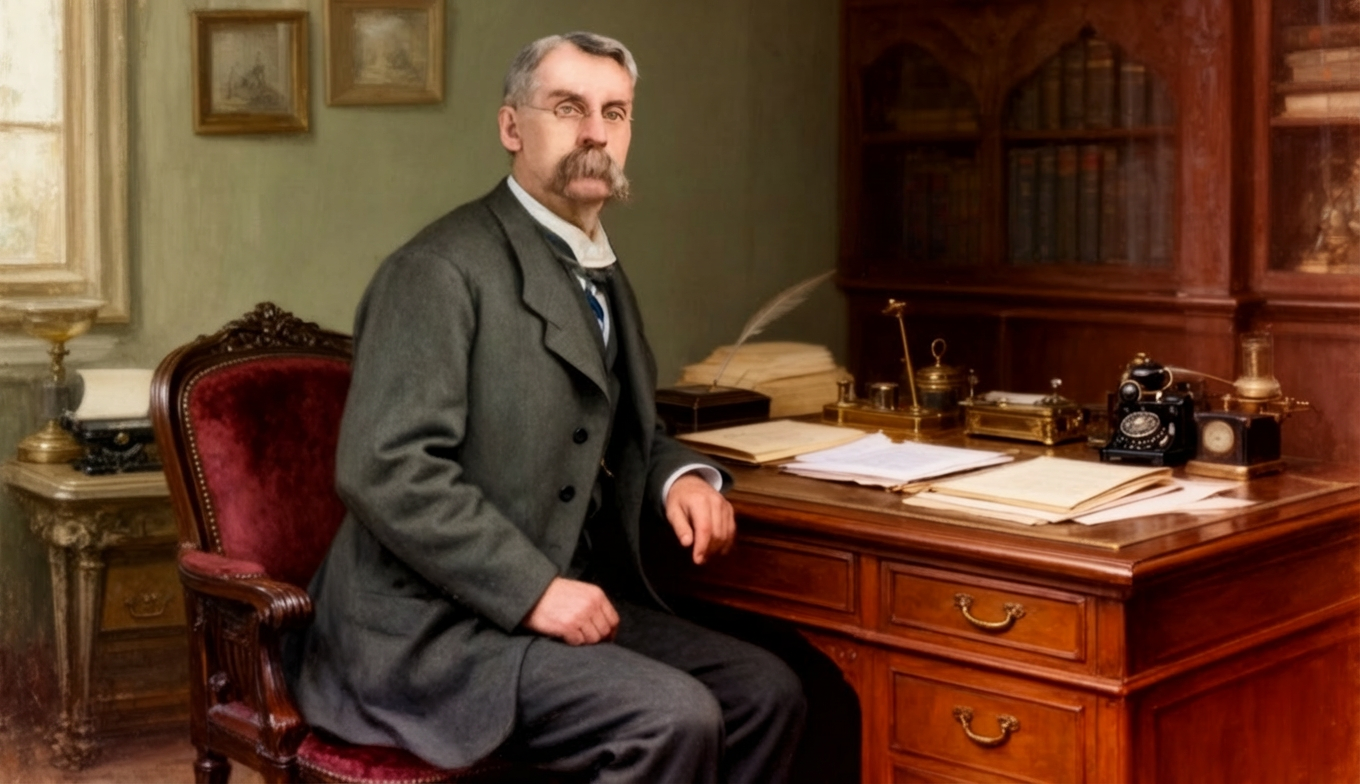

A Holistic Approach: The perspective required for a successful prescription
By Dr James Tyler Kent.
*The Homoeopathician*, 1912.
Translated by Édouard Broussalian and Camille Genton.
Whether a prescription is successful or not depends entirely on whether one is able to identify all of the patient’s symptoms.
Understanding symptoms means viewing the patient’s full range of symptoms across part or all of their body. What more is there to understand than the clinical picture of a case as expressed through symptoms?
The aim of the Art of Healing is to be able to see the full picture of the symptoms, so that the most similar remedy springs to mind. Success depends on seeing this full picture.
A doctor always examines a patient based on his or her overall view of the case. Many doctors never learn to examine a patient until the symptoms, once written down, form a complete picture of the case. Any good prescriber will understand, on reviewing the full range of symptoms, what is missing in order to form a complete picture. But let us now assume that the case has been taken correctly, comprehensively and coherently, with the various symptoms that characterise a perfect record of symptoms.
One might view the case from the perspective of the patient’s condition, or their probable condition.
Another might judge this by the patient’s temperament, the colour of their eyes and hair, or even the star sign under which they were born.
Another will consider it on the basis of the keynotes that he might find there.
Yet another will interpret the patient’s clearly articulated statements in the light of traditional views and reasoning, or the ideas of some doctor who came before him.
This will result in a distorted view of the case.
Furthermore, one may observe a single picture within the whole, or a set of symptoms at one time and a different set at another. If the prescriber bases their decision on the current group and then switches to another group as soon as a change occurs, they will be led to change the remedy every time the picture changes. By the end of the year, it will be easy to see that the patient’s state of health has only worsened. Yet the prescriber has ‘cured’ (?) each group of symptoms, to their own satisfaction and that of the patient. Yet such an approach must nevertheless be regarded as a failure due to an incomplete view of the case as a whole: a partial approach to an incomplete case. In this instance, the prescriber fails to grasp the patient in their entirety if they do not take into account the full range of symptoms.
Making the symptoms disappear cannot restore the patient’s health. Curing the patient will make the symptoms disappear and restore their health (Organon §8).
‘It is therefore the totality of symptoms—the outward manifestation of which is an expression of the inner essence of the disease, that is to say, the disharmonised vital energy; it is this integration of the symptoms that must be the principal or sole means by which the disease enables us to find the necessary remedy, the only one that can determine the most appropriate choice” (§7, Translator’s note)
When symptoms are recorded correctly, it is possible to gain a clear understanding of the case. This is based solely on the symptoms that represent the patient as a whole; all symptoms relating to the modalities and circumstances affecting the organs and body parts; all pathologies of the organs and body parts; and the patient’s age, sex, living conditions and working conditions.
Let us assume that the symptoms to be examined come directly from the patient – from everything that can be seen and heard from the patient and those around them – and are presented to us without the slightest distortion. One reader will take only the pathology into account; another will consider the keynotes ; another of the diagnostic symptoms. On each occasion, something will be overlooked or ignored, or at the very least will not be taken into account in the case in question.
We have never been able to improve the teaching of Hahnemann. We must be guided by strange, rare and unusual symptoms. How can we achieve this?
If we first identify which symptoms are common, it becomes easy to identify those that are anomalous – in other words, rare, strange and unusual.
Common symptoms are the pathognomonic symptoms of diseases and pathological conditions, or those common to many remedies, which are found in the main headings of our repertories, such as: constipation, nausea, irritability, delirium, weeping, weakness, trembling, fever, sweating.
Once such symptoms have been prioritised in a particular case, it will immediately become clear that everything else must be uncommon (anomalous), that is to say, specific, and therefore particular to the patient as a whole, or to their organs in particular.
However, some of these common symptoms can become distinctive when the circumstances are such. For example, a tremor that occurs at certain times or is constant and generalised throughout the whole body and limbs is a pronounced and very troublesome symptom, but is neither distinctive nor abnormal. On the other hand, a tremor before the storm, or whilst riding, or before your period, or even whilst urinating is rare and strange.
Weakness is a common symptom if it is constant, but if it only occurs…before your period, or in front of the saddle, or during the storm, it immediately becomes an anomalous finding and changes the way the case is viewed.
Constant chills are common in many people and represent an important general sign relating to the patient’s overall condition, but if they occur only before or during your period, the saddle, urination, or at night in bed, or even whilst eating, – in which case it becomes a rare and unusual sign, that is to say, anomalous.
None of these symptoms are associated with any known medical condition; they are therefore striking and help to shape one’s understanding the view of a whole.
It is now clear that a doctor who bases their prescriptions solely on pathology is concerned only with what is most common. Without a holistic view, they are therefore violating the basic principles of prescribing. They prescribe solely on the basis of symptoms and consequences, rather than the root causes.
It is important to realise that symptoms which are present in childhood or have been present since childhood – and, generally speaking, all those which existed before the onset of the condition – are the symptoms corresponding to the causes, for all causes are reflected in their effects. These symptoms are not the causes, but they represent them and are often all that can be known about the causes. They provide an overview of the case from the causes to the effects: from the source to the results: the disease. It is important to identify these early symptoms in any chronic illness. Symptoms from childhood to the present day describe the progression of the disease and give the experienced doctor a good overview of the case, including its likely outcomes and the pathology.
It is always wise to bear the pathological manifestations in mind, but these symptoms are of very little value and, outside the context of a complete symptomatic picture, are of no use in helping to find the remedy. However, a doctor must have a thorough understanding of them, as well as of anatomy and physiology, in order to exercise sound judgement and avoid a distorted view of the whole picture.
Symptoms that reflect the patient as a whole are of great, indeed extreme, value, particularly those expressed in the patient’s own words.
Thus, mental symptoms – comprising the patient’s powers of reasoning, their likes and dislikes, and their memory – are of the utmost importance.
Next come the general physical symptoms and their modifying factors, such as cold, heat in all its forms, the weather—whether damp or hot—movement or rest, the time of day, and so on. These symptoms are of the utmost importance when they relate to the body as a whole.
It is important to distinguish between two types of deterioration and improvement: those that apply to the body as a whole and those that concern specific parts. Local symptoms will often be the opposite of general symptoms; care must be taken to consult the relevant sections of the Repertory concerning the affected part.
A woman came to see me about severe rheumatic pain in her shoulder. She entered my surgery with her arm in a sling tightly secured to her body to prevent it from moving, as the slightest movement of the limb increased the pain in her shoulder; yet she was constantly pacing up and down the room in an attempt to relieve her painful shoulder. The pain in her shoulder worsened before a storm. Dulcamara cured her immediately [EB: see Appendix [see below for a discussion of the case]. This demonstrates how a part may possess a modality that is at odds with that of the whole body.
Books that generalise treatment approaches by arbitrarily deciding that any worsening or improvement observed in one part of the body applies to the whole organism have done our cause a great deal of harm. Cold air may worsen the patient’s condition but improve their headache. Bending forwards rarely worsens a headache, back pain, a cough or dizziness to the same degree. Yet Boenninghausen requires you to consult a single section for all these symptoms, with remedies that share the same potency. The patient often feels better with movement, whereas the affected parts, if inflamed, are aggravated by movement.
Lying down exacerbates back pain, headache and breathing to varying degrees, and affects the patient themselves in yet another way. If each symptom is not examined and considered in relation to the specific circumstances affecting it, the outcome will be very different. Certain areas may be relieved by heat, whilst the patient feels better with cold, and vice versa. A headache may be worsened by cold, whilst the patient feels better with heat.
Failure to take these terms and conditions into account amounts to an injustice towards the patient and their representatives.
It is therefore necessary to distinguish between the general provisions and those relating to the parties or bodies; otherwise, the interpretation of a case is significantly altered.
However well the pathological symptoms or the pathology of the case may be understood, this does nothing to inform the homeopathic prescription. General symptoms, without the specific symptoms, can provide a good understanding of the case, except when it comes to prescribing. Relying solely on general symptoms when prescribing leads to failure. In such cases, we might as well prescribe for nervous dyspepsia, gastritis, jaundice, hepatic colic, enteritis, constipation, or a bilious temperament. The main reason for failure among beginners is that they have considered only the general symptoms.
The symptoms of individual parts or organs, taken in isolation, lead to an incomplete or, at the very least, ambiguous picture. It is not possible to derive the patient’s full set of symptoms from them in such a way as to present a complete picture. Something will be missing. Many cases for which my opinion is sought present only local symptoms, without the symptoms that characterise the patient. For the novice practitioner, this is one of the major stumbling blocks.
This point can be illustrated by looking at discharge. Discharge from the inflamed mucous membranes of the ear, nose, throat, windpipe, vagina, etc. is commonplace and is nothing more than a local sign; however, it is neither the location nor the inflammation that causes the discharge to be green, bloody or viscous. This can only be due to a change in the body’s overall constitution. Consequently, the significance of the symptom becomes general. Its limited value as a common symptom increases as it becomes a specific symptom. The entire picture of the case is thereby altered. A healthy discharge is natural and common. So let me reiterate that whilst inflammation is accompanied by discharge, this in no way determines the colour.
The same applies to blood when it is in a liquid state and fails to form a clot; this is an unusual and rare occurrence.
The symptoms that characterise one’s entire mental and physical state sometimes lead to such view in cases where the remedy becomes obvious. Let us reiterate, however, that all the classes of symptoms we have just listed are necessary to provide a view of the past and the present. When such a view presents itself, prescribing becomes easy.
To make prescribing easier, one must succeed in obtaining this perfect overview of the entire case; this can be expressed by saying that ‘the totality of the morbid signs and symptoms is the sole basis for a homeopathic prescription’, as Hahnemann He taught this many years ago. Negligence in taking symptoms, or in studying them once they have been written down, inevitably leads to poor results. It must be remembered that it is not the totality of symptoms recorded by an ignorant or careless doctor that forms the basis for a homeopathic prescription, but rather the totality of symptoms that the patient actually presents.
Faced with a patient who has a delayed, absent or scanty period, who is crying, and who shows an aversion to fatty foods, nausea, vomiting and a feeling of heaviness after eating, the young practitioner will immediately suggest Pulsatilla; just a moment, please. If the patient is very sensitive to the cold, prefers to stay at home, never needs to have the window open, is aggravated by movement, and prefers to keep quiet, you will now change your mind and prescribe Cyclamen. On the other hand, if she is relieved by movement and being outdoors, loves being out and about, and is often too hot, then Pulsatilla is the right choice.
A doctor cannot be careless and claim to cure as if Hahnemann did it.
I wanted to examine how Kent arrives at the prescription of Dulcamara, the indication for which is far from obvious (at first glance, I would have suggested Rhododendron).
Let’s start with the general rubric that applies to the patient. There’s no problem here; we look under ‘General’ for the rubrics ‘Walking’, ‘Enamel’ or ‘Enamel Movement’.
Let us now consider the worsening of symptoms before the storm. Locally, in Douleur Épaule < Before the storm, there is only Rhododendron, the sole remedy. If one does not look any further, this remedy seems appropriate, as it is also listed under the third degree in the general rubric > movement. That said, we shall see later that it is dangerous to rely solely on such ‘mini’ sections and that it is far safer to refer to the ‘General Information’ section, ‘Weather’ < before the storm
We must now also take into account the fact that the pain is aggravated by movement of the affected area. But which part? It is not only movement of the shoulder that aggravates the pain, but also movement of the arm, or of any part of the limb. Therefore, the general rubric ‘Limbs, Pain, Movement, aggravated’ should be used.
This subtlety calls for a few comments.
If one takes the scope of this provision lightly, one should refer to the section on shoulder pain < in the section on movement. Dulc is not listed there. But Rhod is: as Kent says, this radically changes the outlook on the case. The general section on pain in the limbs contains a short list of remedies < to movement (as is the case in this section, the general headings are often much shorter than the specific headings) because these are the few remedies for which the modality applies to the whole limb. It follows, as is the case throughout the repertory, that the remedies in this rubric may be added to all sub-rubrics < movement accompanied by pain in the limbs. Therefore, if you do not use the correct rubric straight away, you must at least know how to supplement a local rubric with remedies from the rubric that captures the general meaning; this prevents you from making a mistake that could prove fatal (when using PCKent’s generalisation module, there will be no problem in entering a very local modality first, as the computer will soon be able to use the more general rubrics to supplement it).
By comparing Hering’s Encyclopaedia with the contents of the repertory point by point, as we have been doing for years, we have already been able to highlight and understand these mechanisms of generalisation which underpin the reliability of Kent. In short, Kent always generalises sparingly, but judiciously. Consequently, there are very few concomitants in the repertory. Upon careful reflection, the reason becomes clear. This would make the work considerably more cumbersome, whilst introducing many errors due to a lack of generalisation. Indeed, apart from certain concomitants confirmed by 100 years of experience—such as the heat in the head accompanied by coldness of the body in Arnica—it must be understood that a remedy may produce two symptoms simultaneously in a given subject, without this necessarily implying a connection between them. For example, remedy X produces abdominal pain alongside a headache. Should we create two rubrics—one for ‘headache with abdominal pain’ and the other for ‘abdominal pain with headache’—each containing remedy X? Is it not more logical, as Hering’s cross allows us to deduce, to add remedy X to the ‘headache’ rubric on the one hand, and to the ‘abdominal pain’ rubric on the other? Clearly, this is the choice Kent made, and it is therefore the approach we must follow if we wish to continue his work.
Alas, if you study modern repertoires – all of which are based on Kent’s repertoire, even though his name no longer appears on the cover – you will be appalled to find that all these subtleties are completely overlooked, which makes the result highly open to criticism. Jacques Baur used to tell me that nothing beats a good cobbler who is used to his old tools. That is a hundred times true.
However, this particular case cannot be resolved without knowing that Dulcamara is characterised by general aggravation prior to a storm. Yet, in no American edition of the repertory does Dulc appear under the heading ‘Generalities’ < before the storm... Yet, if one consults the materia medica, this modality is indisputable. In my translation, and in PCKent, you will indeed find Dulc cited by Boger in a short work entitled "Additions to Kent’s Repertory "a large proportion of which are said to come from Kent’s handwritten notes on his repertoire. In the end, here is the list:
|
Wording of |
V R |
Dulc |
Zinc |
Rhod |
High school |
Rhus-t |
Agar |
Aur |
Gels |
Remedy |
|
26 |
26 |
20 |
20 |
20 |
20 |
20 |
20 |
Overall Value |
||
|
3 |
3 |
2 |
2 |
2 |
2 |
2 |
2 |
Occurrence |
||
|
5 |
4 |
6 |
5 |
5 |
4 |
4 |
4 |
Total |
||
| Ge: WEATHER / thunderstorm or storm / before_ |
4 |
1 |
1 |
3 |
2 |
2 |
2 |
1 |
2 |
Degree |
| Ge: MOVEMENT / amél_ |
4 |
3 |
2 |
3 |
3 |
3 |
2 |
3 |
2 |
Degree |
| Mb: PAIN / movement / aggravation when_ |
2 |
1 |
1 |
Degree |
We must therefore improve the indexing tool, but we must do so properly, as distorting it or introducing errors into it cannot be called progress