

Methods of administering homeopathic medicines
by Athelas

The Sense of Smell (illustration by Hans Ulrich OSTERWALDER)
Last summer, on the website’s Facebook page, we advised adding just a few globules of Psorinum to the water used to water diseased box trees infested with the box tree moth [see here]. Following the large number of messages received and comments from sceptical readers asking whether two globules actually meant two full ‘doses’, that is to say two whole tubes, I wrote a short article at the time – presented here in a slightly revised version – which outlined the principle of the minimum quantity and set out the various methods of administration for administering it.
In fact, after
- the one and only remedy and
- the potentised remedy,
- The minimum quantity [1] is, however, the third essential pillar established by Samuel Hahnemann as the foundation of homeopathy, which is the method enabling the law of similars to be applied effectively.
This goes to show how the indoctrination carried out for decades by pharmaceutical companies – whose influence also extends widely into the training of doctors and pharmacists wishing to learn homeopathy – has stripped our wonderful therapeutic approach of its substance (of all things!) our wonderful therapeutic approach by making the self-serving prescription of full doses the norm.
Having discussed the single remedy [for example here], dosage and frequency [here] of the potentised remedy, let us now, as promised, look at an introduction to the various methods of administering homeopathic medicine – that is to say, the different ways of taking it. There is more than one! Whilst our patients are now familiar with these methods, many of our readers are probably still unfamiliar with the liquid method (globules dissolved in water), and few of them have heard of olfaction, which involves inhaling the remedy contained (most often) in an alcohol-based bottle. And yet these methods are just as effective as taking the remedy dry (directly into the mouth), and perhaps even more so.
In the sixth and final volume of the *Organon*, HAHNEMANN summarises the last twenty years of his life, which he spent conducting experiments to discover ‘ "the best possible way to administer doses of medication to patients".
Organon § 284
In addition to the mucous membranes:
— language,
— the mouth and
— of the stomach,
which are the most common sites of absorption for the medicine,
— those of the upper respiratory tract, that is to say, the nose and pharynx, and
— those of the lower respiratory tract
are also highly sensitive to the effects of the vapours from liquid medicines, if these are administered via nasal or oral inhalation.
However,
— the entire surface of our skin, covered by its intact epidermis, is capable of responding to the action of dissolving medicines, particularly if a medicinal rub is applied at the same time as the same remedy is taken internally. [translated by Edouard BROUSSALIAN]

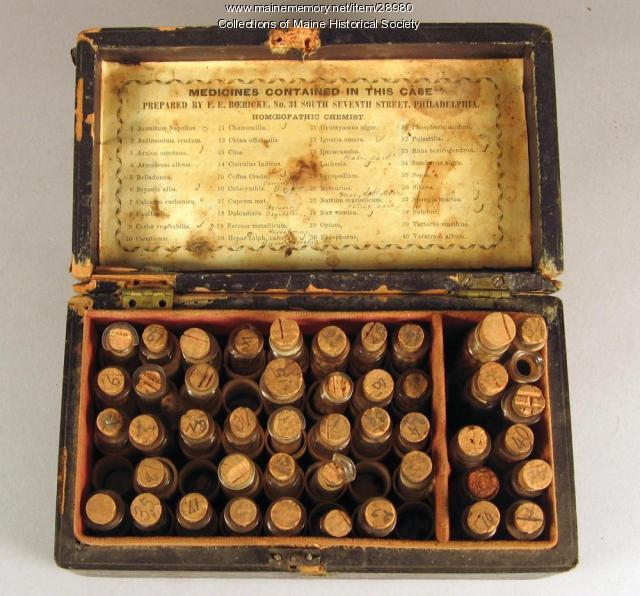
Maine Historical Society, www.MaineMemory.net item 28980
Why are there several methods? Essentially so that, in each individual case to be treated, the administration results in nothing other than’as little disruption as possible [1]. Indeed, there is no point in triggering a similar worsening of symptoms in a hypersensitive patient by administering too large a dose of medication.
However, the use of medicinal remedies and the sense of smell will make it possible to tailor the dose precisely to each patient’s individual sensitivity. In 1837, HAHNEMANN wrote: “ Nevertheless, the incredible diversity of patients’ sensitivities, their ages, their physical and spiritual development, their vitality and, in particular, the nature of their illnesses require a wide variety of treatments, as well as methods for administering them. » [2]
How do we assess a patient’s sensitivity? By taking into account, as Hahnemann points out, their age, constitution, temperament, the nature of their illnesses (miasms), their energy levels (‘reserve’ of vital force), their general ability to respond (for example, to physical stimuli in their environment or to distressing situations that trigger emotions), etc. Finally, by asking them about the reactions they may have experienced following previous homeopathic (and even allopathic) treatments.
Each method has its own advantages (for example, the routes of administration differ: oral mucosa, respiratory tract, skin) and, above all, its own indications, which we shall discuss; it is up to the homeopathic doctor to determine which one is appropriate in each individual case.
Doctors in the early nineteenth century who embraced the homeopathic paradigm, at a time when the fledgling vitalist school of medicine was on the cusp of new discoveries, were deeply driven by a desire to experiment in order to advance their understanding of how to influence the mechanisms governing living organisms, through the use of potentised remedies. Hahnemann’s guidelines, which evolved with each successive edition of the Organon, served as a framework for treating diverse populations suffering from all manner of diseases, particularly serious infectious diseases that severely impair the vital force. It is likely that many of the practical methods and ingenious techniques for preparing and administering remedies, which stemmed from their research, were lost with the passing of these experienced practitioners at the dawn of mass chemical medicine in the early 20the century. Here is yet another reason to read the homeopathic books and journals of that era, to discover what is still relevant today and to draw inspiration from them. This is our heritage, which contains the sound and time-tested foundations of homeopathy.

Constantine HERNG 1800–1880
This is how the great Hering, «the father of American homeopathy», went about it; he devotes a few lines to this subject in his practical handbook « The homhomeopath, or family doctor » [3]. They also highlight the importance attached to the quantity administered, regardless of the method of administration, and at the same time provide a historical insight into the richness of homeopathy. Hering’s indications are logical and precise, but one must bear them in mind when prescribing.
It is estimated that Hering treated fifty thousand patients a year, assisted in this task by students from the first American homeopathic college, which he founded. Some biographers recount – perhaps in a somewhat romanticised manner – that he wrote this guide, first published in 1835, for the inhabitants of Paramaribo, in what is now Suriname, which he had been forced to leave to move to Pennsylvania in the United States. One of his students and friends, who was grappling with an outbreak of Asian cholera, had called on him to come and join him there. In any case, his book became the bedside reading of generations of young practitioners [4].
How to use medicines [5]
«Homeopathic medicines can be used in various ways:
1. by inhalation; 2. by taking one or two globules; 3. in solution in water. [6]
1° In terms of smell, when the pain is very severe but does not, however, pose the slightest danger, as in the case of headaches, toothache, stomach ache and chest ailments [cough, hoarseness], in young children, and in all those who are easily affected by the action of medicines. In these various cases, it is sufficient to let the patient smell the stopper of the uncorked bottle containing the appropriate remedy. (…) In the case of children, one should choose the time when they are asleep [7]. One or two inhalations from the cap are sufficient. (…)
2°In globules in all chronic illnesses in robust individuals, in cases where the symptoms are not too severe, in accidents resulting from falls, in stomach upsets accompanied by frequent or violent vomiting, and in most other common cases. In these various circumstances, one or two small medicinal globules are administered in their dry state. To do this, one or two globules are dropped from the bottle in which they are contained; once they have fallen into the palm of the hand, the patient picks them up with their tongue, or alternatively they are placed on a clean, dry spoon and dropped into the patient’s mouth;
3° In solution, in all dangerous cases, in chronic illnesses, when many medicines have already been taken and the condition has worsened, and in all cases where neither the olfactory remedy nor the dry globules have proved beneficial. (…) After placing two or three globules in a glass, fill it with water; then pour the water from the glass into a second glass, then back into the first, and repeat this four or five times in succession. In this way, the medicine mixes properly with the water. If only one clean glass is available, the water should be stirred by swirling a clean spoon around ten to twelve times. An adult should be given one tablespoon; one teaspoon should be given to children [8]. Or they can take a sip from the glass.»
Nowhere is there any mention, regardless of the method used, of administering a large quantity of the medicine, let alone whole dry doses. Moreover, Hering clearly states that administering dry granules may be poorly tolerated (!) and that this option should be reserved for specific indications, particularly for «strong individuals», that is to say, those with a robust physical constitution, and those whose vital force has not been weakened by prolonged and gruelling allopathic treatments.
The guidelines provided by Hering are not exhaustive. Bear in mind that the olfactory route is also the safest way to administer the smallest quantity at the highest potency:
- a remedy with a high degree of homeopathic suitability (i.e. one that is perfectly suited to the case): for example, at the start of a chronic case with no significant structural or organic damage, and particularly when there is a strong emotional component (certain structures of the brain traditionally grouped under the term ‘limbic system’, which are involved in the processing of emotions, are also involved in memory formation and the olfactory system; once again, everything is interconnected).
- a nosode or an anti-miasmatic remedy: for example, in cases where significant miasmatic activity suppresses the vital force’s ability to manifest a clear homeopathic picture.
All of this can be learnt, and it must be studied properly before being practised. Our aim was to introduce the public to the different ways of taking a homeopathic remedy and to raise their awareness of the concept of quantity. Homeopathy is not simply a matter of taking one tube (or, unfortunately, several) of granules and following a fixed prescription of 3 or 5 granules to be placed under the tongue at regular intervals, regardless of the patient or the condition being treated.
1. see HAHNEMANN, Organon 6th edition §275–279
The reader should understand clearly that we do not specify the minimum quantity simply for the sake of it. Hahnemann writes, with reference to the therapeutic ideal set out in paragraph 2 of theOrganon, that the therapeutic response must be ‘gentle’, without causing ‘significant unpleasant side effects’. However, the aim remains to elicit a response capable of bringing about progress in the patient’s condition. It is also important to bear in mind that the dose must be increased when it is no longer sufficient to maintain optimal progress towards recovery.
2. The history of the development and continuous refinement of homeopathy by HAHNEMANN is beautifully explained in a series of articles written by David LITTLE :
3. https://archive.org/details/9604401.nlm.nih.gov
There have been a great many reprints in various languages, with translators adding all sorts of increasingly dubious material, to the extent that the French versions, for example, very quickly came to bear no resemblance whatsoever to Hering’s original text. I would advise against them.

4. «We have always regarded Dr Hering’s guide as the best and most original of the domestic works» (British Quarterly Journal of Homœopathy), quote taken from the « Critical Dictionary of English Literature»which states in its first volume, dated 1859, that 50,000 copies of the guide were already in circulation, across all editions – which is no mean feat!"
https://books.google.fr/books?id=Ddj6hE2m_egC&pg=PA832#v=onepage&q&f=false
5. A French translation revised by myself, based on Léon Marchant’s 1850 version, which already takes certain liberties with regard to the quantities recommended by Hering (naturally, he increases them, as it goes against human nature to give so little).
https://archive.org/details/mdecinehomoeopa03herigoog, see pages 8–10
Despite my best efforts, I have been unable to get hold of the first French edition of *Marchant*, published in 1848.
6. As we have seen with HAHNEMANN, the remedy can also be rubbed onto the skin using the solution in certain circumstances. One final point: Hahnemann also insisted that, in the case of breastfed babies, it should be the mother (or, in the past, a wet nurse) who takes the remedy and then passes it on to the child via her breast milk.
7. Whilst Hering appears to make particular use of and value the sense of smell, he pays little heed to the placebo effect that may be linked to the act of smelling (or even to the gesture itself), since he has the child inhale whilst he was asleep the vapours from the alcohol-filled bottle containing the remedy. 🙂 Hahnemann does not hesitate to state in §288 of the fifth Organon that this method is certain to produce an effect.
8. And certainly even less so these days, given the decline in people’s health.