

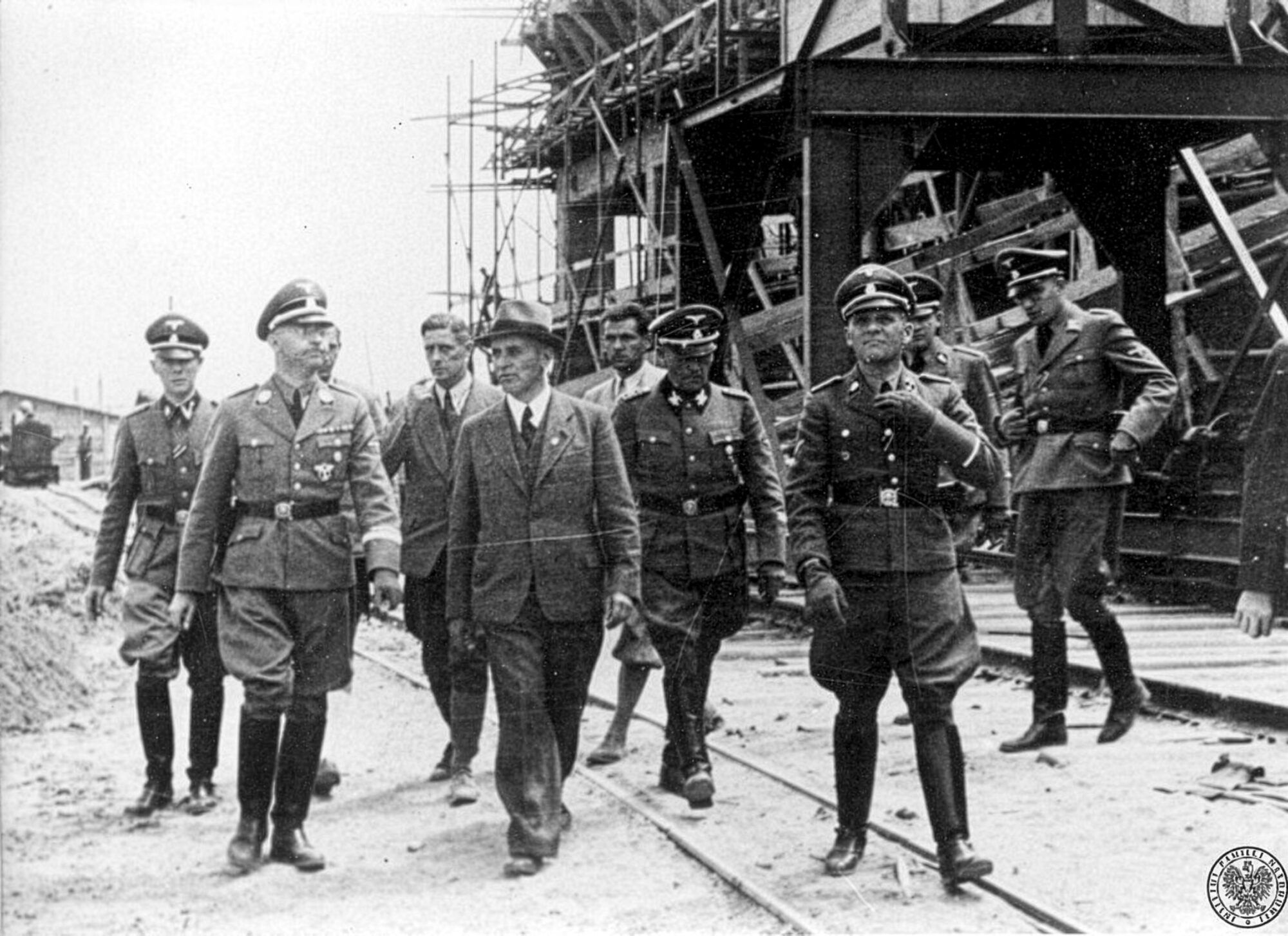
To continue our discussion, it is worth recalling some little-known historical details. To this end, I have translated the article from the Rath Foundation. 
« The best A powerful German economic group in the first half of this century was the Interessengemeinschaft Farben, or IG Farben for short. ‘Interessengemeinschaft’ means ‘Association of Common Interests’ and was nothing more than a powerful cartel comprising BASF, Bayer, Hoechst and other German chemical and pharmaceutical companies. IG Farben was the largest donor to Adolf Hitler’s election campaign. A year before Hitler seized power, IG Farben donated 400,000 marks to Hitler and his Nazi party. Consequently, after Hitler came to power, IG Farben became the biggest beneficiary of Germany’s conquest of the world during the Second World War..
[Anyone wishing to gain an insight into the power of the pharmaceutical companies in Germany at that time will find this an interesting read Total ecstasy, or how the drug trade created a thriving empire. The book also examines the ‘mind-boggling’ impact of Pervitin, which was only painstakingly withdrawn from the market long after the war…]
« One hundred per cent of all explosives and synthetic petrol came from IG Farben’s factories. Whenever the German Wehrmacht invaded a new country, IG Farben followed, systematically taking control of those countries’ industries. Through this close collaboration with Hitler’s Wehrmacht, IG Farben participated in the plundering of Austria, Czechoslovakia, Poland, Norway, the Netherlands, Belgium, France and all the other countries conquered by the Nazis.
« The US government’s 1946 inquiry into all the factors that led to the Second World War concluded that, without IG Farben, the Second World War simply would not have been possible. We must understand that it was not the psychopath Adolf Hitler or the ‘bad genes’ of the German people that caused the Second World War. The economic greed of companies such as Bayer, BASF and Hoechst was the key factor behind the Holocaust..
« Anyone who has seen Steven Spielberg’s film *Schindler’s List* will never forget the scenes set in the Auschwitz concentration camp.
The founding of IG Farben and support for Hitler (extract from the book *Sword and Swastika* by Telford Taylor)
“After the First World War, all the major chemical companies were merged into a single, gigantic trust in 1926 – I.G. Farbenindustrie A.G. – under the leadership of Carl Duisberg and Carl Bosch. Dyes, pharmaceuticals, photographic supplies, explosives and a myriad of other products flooded the market in ever-increasing volumes and varieties.
“Shortly after the July 1932 election, in which the Nazis had doubled their share of the vote, Heinrich Buetefisch [head of the I.G. Farben factory – Leuna] and Heinrich Gattineau [a Farben official who was also an SA officer and whom Rudolf Hess and Ernst Röhm knew personally]. waited for the future Führer to give his views on whether Farben could count on government support for its synthetic petrol programme should the Nazis come to power. Hitler readily agreed that Farben should receive the support necessary to justify the expansion of the Leuna plant.
‘After seizing power, Farben wasted no time in following up on this promising initiative. It is significant that the channel chosen by Farben was not the ‘Heeresleitung’ but Hermann Goering’s new Air Ministry. In a lengthy letter to Goering’s deputy, Erhard Milch, Carl Krauch of Farben outlined a ‘four-year plan’ for the expansion of synthetic fuel production. Milch then consulted Lieutenant General von Vollard Bockelberg, head of the Army Artillery Office, and it was agreed that the Army and the Air Ministry would jointly sponsor the Krauch project. A few months later, Farben received an official contract from the Reich providing for the expansion of the Leuna plant so that production would reach three hundred thousand tonnes per annum by 1937, with Farben’s sales guaranteed for ten years – until 30 June 1944 – on the basis of cost price plus a mark-up.
I.G. Farben and the Auschwitz concentration camp
‘Auschwitz was the largest mass extermination factory in human history, but the concentration camp was merely an appendage.’
“The main project was IG Auschwitz, a wholly-owned subsidiary of IG Farben, the world’s largest industrial complex for the production of synthetic petrol and rubber for the conquest of Europe.”
“On 14 April 1941, in Ludwigshafen, Otto Armbrust, a member of the IG Farben board of directors responsible for the Auschwitz project, told his colleagues on the IG Farben board:
“Our new friendship with the SS is a blessing. We have identified all the measures that will integrate the concentration camps for the benefit of our company.”
“The pharmaceutical divisions of the IG Farben cartel exploited the victims of the concentration camps in their own way: thousands of them died during human experiments, such as trials of new and untested vaccines. There was no retirement scheme for prisoners at IG Auschwitz. Those who were too weak or too ill to work were selected at the main entrance to the IG Auschwitz factory and sent to the gas chambers. Even the Zyklon-B chemical gas used to exterminate millions of people originated from the drawing boards and factories of IG Farben.
Medical experiments at Auschwitz carried out by I.G. Farben. (extract from the book *I.G. Farben – From Aniline to Forced Labour* by Jörg Hunger and Paul Sander)
“Scientific experiments were also carried out in other concentration camps. A key fact is that Dr Helmuth Vetter, an SS major with the IG who was stationed at several concentration camps, took part in these experiments on the orders of Bayer Leverkusen.”
“At the same time, Dr Joseph Mengele was conducting his experiments at Auschwitz using drugs designated ‘B-1012’, ‘B-1034’, ‘3382’ or ‘Rutenol’.” The test preparations were administered not only to sick prisoners, but also to those in good health. These individuals were deliberately infected for the first time via pills, powdered substances, injections or enemas. Many of these drugs caused the victims to vomit or suffer bloody diarrhoea. In most cases, the prisoners died as a result of the experiments.
“Correspondence between the camp commander and Bayer Leverkusen was discovered in the Auschwitz files. It concerned the sale of 150 female prisoners for experimental purposes: ‘In view of the planned experiments with a new sleeping pill, we would be grateful if you could make a certain number of prisoners available to us (…)’ – ‘We confirm your reply, but consider the price of 200 RM per woman to be too high. We propose to pay no more than 170 RM per woman. If this suits you, the women will be handed over to us. We require approximately 150 women (….)” – “We confirm your approval of the agreement. Please prepare 150 women for us who are in the best possible health (….)” – “Order for 150 women received. Despite their state of maceration, they were deemed satisfactory. We will keep you informed of developments regarding the experiments (….)” – “The experiments have been carried out. All test subjects have died. We will contact you as soon as possible regarding a new shipment (….)”.
“A former Auschwitz prisoner recalls: ‘There was a large tuberculosis ward in Block 20. The Bayer Company sent medicines in the form of unmarked, label-free ampoules. These were injected into the tuberculosis patients. These unfortunate people were never killed in the gas chambers. All we had to do was wait for them to die, which didn’t take long (…) 150 Jewish women who had been bought by Bayer from the camp guard, (….) were used for experiments with unknown hormonal preparations.”
“Alongside the trials conducted by Behringwerke and Bayer Leverkusen, Hoechst’s chemical-pharmaceutical and serological-bacteriological department began conducting experiments on prisoners at Auschwitz using their new preparation ‘3582’ against typhoid fever. The first series of trials yielded results that were far from satisfactory. Of the 50 people tested, 15 died; the typhoid fever medication caused vomiting and exhaustion. Part of the Auschwitz concentration camp was placed under quarantine, which led to the trials being extended to the Buchenwald concentration camp. In the journal of the ‘Department of Typhoid Fever and Viral Research at Buchenwald Concentration Camp’, we find the following entry dated 10 January 1943: ‘As suggested by IG Farbenindustrie A.G., the following drugs were tested as treatments for typhoid fever: a) preparation 3582 from the Chemical and Serobacteriological Pharmacy. Hoechst Department – Prof. Lautenschläger and Dr Weber – (therapeutic trial A), b) methylene blue, previously tested on mice by Prof. Kiekuth, Elberfeld (therapeutic trial M)”.

“The first and second series of therapeutic trials, which took place at Buchenwald between 31 March and 11 April 1943, proved unsuccessful due to insufficient infection among the prisoners tested. Nor did the experiments at Auschwitz yield any clear successes.
“The scientific value of all these experiments, whether or not they were commissioned by IG Farben, was in fact nil. The test subjects were in poor physical condition, caused by forced labour, insufficient and poor-quality food, and illnesses in the concentration camp. Furthermore, sanitary conditions in the laboratories were generally poor. ‘The results of the tests carried out in the concentration camps, as the specialists at the IG laboratory should have known, could not be compared with results obtained under normal circumstances.’
“The SS doctor, Dr Hoven, testified to this at the Nuremberg trials: ‘It must be understood, particularly within German scientific circles, that the SS did not have any prominent scientists at their disposal. It is clear that the experiments in the concentration camps using IG’s preparations were carried out solely in the interests of IG, which made every effort to determine the effectiveness of these preparations. They left the SS to do the dirty work in the concentration camps. The IG had no intention of making these experiments public, but rather of creating a smokescreen around them so that (….) they could keep all the profits for themselves. It was not the SS, but the IG that took the initiative for the experiments in the concentration camps.”
The Nuremberg War Crimes Tribunal
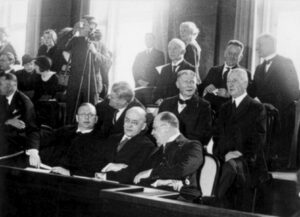
A fine bunch of scoundrels who’ll never be held to account
“The Nuremberg War Crimes Tribunal convicted 24 members of the board of directors and executives of IG Farben on charges of mass murder, slavery and other crimes against humanity. Surprisingly, however, by 1951, all had already been released and were continuing to act as consultants for German companies. The Nuremberg Tribunal dissolved IG Farben into three entities: Bayer, Hoechst and BASF.
“Today, each of IG Farben’s three subsidiaries is 20 times larger than IG Farben was at its peak in 1944, the final year of the Second World War.”
‘More importantly, for nearly three decades after the Second World War, every chief executive of BASF, Bayer and Hoechst (now Aventis) held the highest position – that of chairman of the board of directors – alongside former members of the Nazi NSDAP:’
Carl Wurster, who served as chairman of the board of directors at BASF until 1974, was, during the war, a member of the board of directors of the company that manufactured Zyklon-B gas.
Carl Winnacker, chairman of the board of directors at Hoechst until the late 1970s, was a member of the Sturmabteilung (SA) and a member of the board of directors at IG Farben.
Curt Hansen, chairman of Bayer’s board of directors until the late 1970s, was a key figure in the conquest of Europe within the ‘raw materials procurement’ department. Under his leadership, the successor companies to IG Farben – BASF, Bayer and Hoechst – continued to support politicians who represented their interests.
“During the 1950s and 1960s, they invested in the political career of a young representative from a suburb of the BASF town of Ludwigshafen; his name was Helmut Kohl.”
“From 1957 to 1967, the young Helmut Kohl was a paid lobbyist for the ‘Verband Chemischer Industrie’, the umbrella organisation for the German pharmaceutical and chemical cartel. In this way, the German chemical and pharmaceutical industry put forward one of its own political representatives, leaving the German people with nothing more than the choice of giving their final approval.”
“The outcome is well known: Helmut Kohl served as Chancellor of Germany for 16 years, and the German pharmaceutical and chemical industry became the world’s leading exporter of chemicals, with subsidiaries in more than 150 countries – more than IG Farben ever had. Several billion people will die prematurely. Germany is the only country in the world where a former lobbyist paid by the chemical and pharmaceutical cartel was at the head of the government. In short, German policy’s support for the global expansion plans of German pharmaceutical and chemical companies has a century-long tradition.
“With this in mind, we can understand Bonn’s support for the Codex Commission’s unethical plans. (Comment made by the Dr Rath Health Foundation)”
“The chief prosecutor at the Nuremberg War Crimes Tribunal against IG Farben anticipated this development when he stated:
“These IG Farben criminals, and not the lunatic Nazi fanatics, are the principal war criminals. If the guilt of these criminals is not exposed and if they are not punished, they will pose a far greater threat to future world peace than Hitler would if he were still alive.”
Here’s a long list of bastards in suits and ties that you’ll come across directly on the website. All of them have been smoothly re-employed in various ministerial or industrial posts. Anyone who isn’t feeling sick after reading what we’ve just gone through might want to start thinking about seeing a psychiatrist.
We have seen how a harmful industry has taken over medicine – and probably power as well – and maintains its hold through unlimited means of manipulation and the engineering of consent. It shapes public opinion and trains doctors from the moment they enter university. It funds all manner of smear campaigns on the one hand, and promotional campaigns for its products on the other. It covers up its crimes and reaps colossal profits from them. It sows intellectual terror in the press, the media and on social media with the help of ‘science brigades’ whose members have little to be proud of apart from having learned to walk on two legs. As the direct heir to IG Farben, the chemical industry has skilfully changed its image, but its lethal, and its hegemonic drive for unlimited, unscrupulous profit, already makes these entities responsible for crimes against humanity, as evidenced by the charges against Monsanto; and it is likely that each will have to answer for charges not dissimilar to those in the Nuremberg trials, which seem to have served no purpose.
Read the Part One of the article